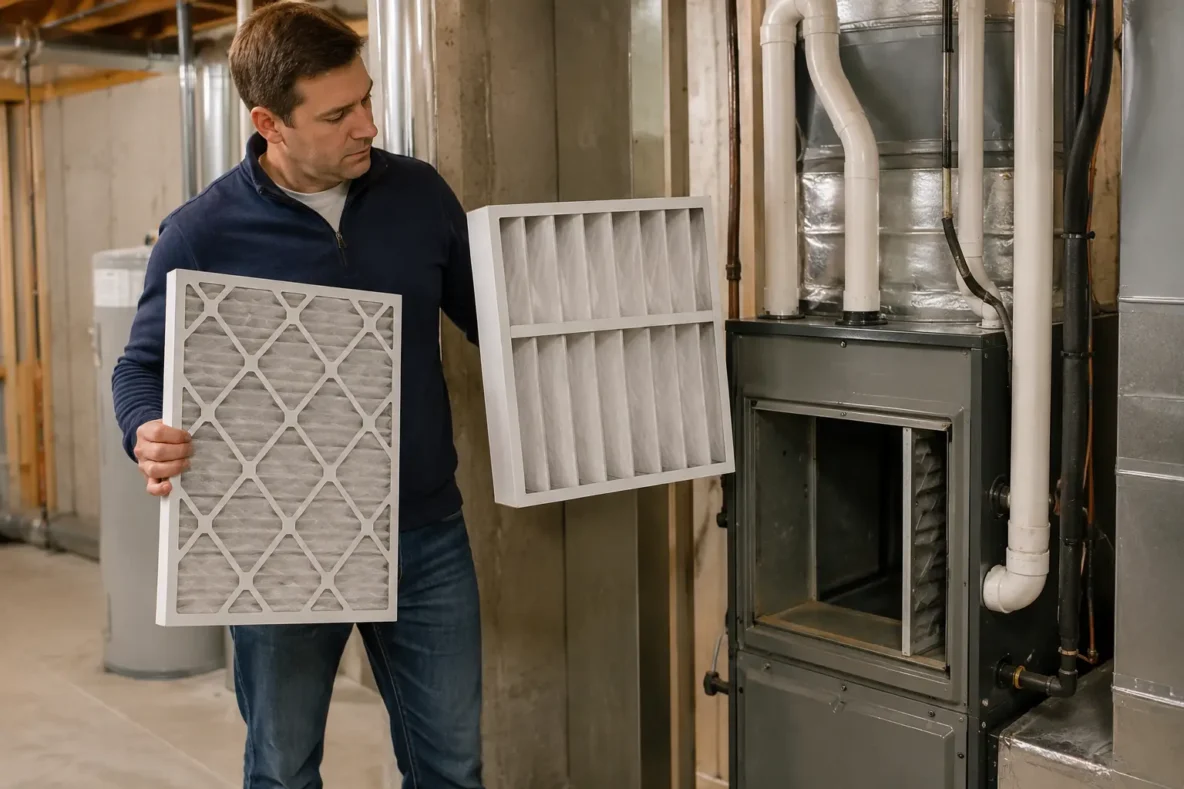
Most furnace filters need to be replaced every one to three months. Thicker filters, the four-inch and five-inch versions used in media cabinets, can last 6 to 12 months between changes. That is the standard range you will hear from almost any HVAC technician, and it is a good starting point.
But it is only a starting point. Two houses on the same street, running the same brand of furnace, can wear out a filter at completely different rates depending on who lives in them and what they do. A house with two dogs and a shedding cat needs a different schedule than a single person working from a downtown office all day.
Below is how to figure out where your home actually falls on that range, the signs that tell you before the calendar does, and why the heating season tends to push most homes toward the shorter end.
Filter replacement schedule by type
Filter lifespan depends mostly on thickness. Standard one-inch and two-inch filters, the kind found in most furnaces built before the mid-2000s, need to be replaced every 1 to 3 months. Four-inch and five-inch media filters, common in newer high-efficiency systems, last six to twelve months. HEPA filters used in dedicated whole-home filtration add-ons typically fall within the same six-to-twelve-month range, though heavier household use can shorten it.
Here’s how the main filter types compare:
| Filter type | Typical replacement interval | Common in |
| 1-inch or 2-inch standard/pleated | 1 to 3 months | Older or standard-efficiency furnaces |
| 4-inch or 5-inch media filter | 6 to 12 months | Newer high-efficiency systems with a media cabinet |
| HEPA filter | 6 to 12 months | Dedicated whole-home filtration systems |
| Washable/reusable filter | Rinsed monthly, replaced only when worn | Some older furnaces and specialty setups |
Thicker almost always means longer between changes, but nothing on this table is a substitute for actually looking at the filter. The EPA recommends checking it monthly, regardless of type, especially once the heating season starts, and changing it as soon as it looks dirty rather than waiting for a calendar date.
Signs your filter needs replacing
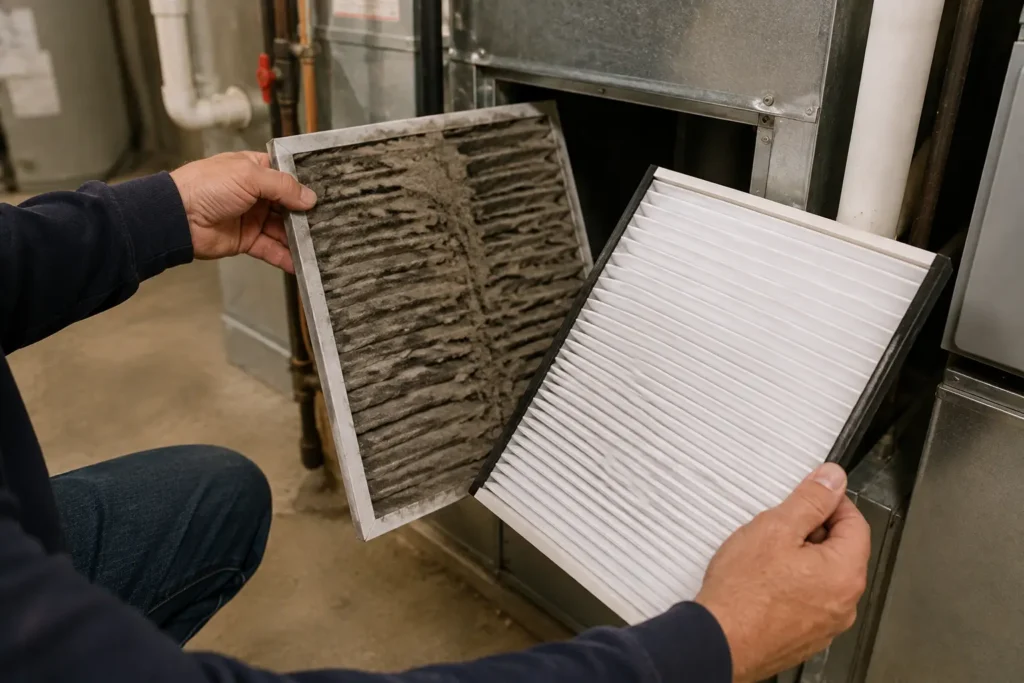
A filter is overdue when it looks gray instead of white, when the furnace runs longer cycles than it used to, when rooms heat unevenly, or when the energy bill climbs with no change in usage. Any one of these on its own is worth a look today, not next week.
- Visible gray or brown buildup instead of the filter’s original white or off-white color.
- Longer heating cycles. A furnace that used to warm the house in fifteen minutes and now takes twenty-five is usually fighting restricted airflow.
- Uneven heat between rooms, especially the ones farthest from the furnace.
- A rising gas or electric bill with no real change in how the thermostat gets used.
- Faster dust buildup around vents and furniture, sometimes paired with a faint musty smell.
None of these shows up the same day the filter clogs. They build gradually, which is exactly why catching them early, whether through a monthly glance or during a scheduled precision tune-up, heads off bigger problems down the line.
What actually changes your filter’s lifespan
Pets, allergy sufferers, larger households, and smokers in the home all shorten a filter’s working life, sometimes by half. A single-occupant home with no pets can often stretch a filter toward the long end of its range. A busy household with dogs and cats usually can’t.
A home with a dog or two cats loads a filter with hair and dander fast, often cutting a standard one-inch filter’s interval toward the one-month mark. Households managing allergies or asthma benefit from checking more often than the standard schedule, since a partially clogged filter starts losing capture efficiency before it looks obviously dirty.
More people in the house means more skin cells, hair, and general dust in circulation, which is why a family of five typically changes filters faster than a couple living alone. Smoking indoors adds a layer of particulate and residue that a standard filter was not really built to handle at high volume, and it wears one out noticeably faster, too.
Does a higher MERV rating mean you change it less often?
Not really, and a higher MERV rating is not automatically better for your system either. MERV measures how fine a particle a filter can trap, on a scale of 1 to 16 for most residential filters. Most furnaces are designed with filters in the MERV 8-13 range. Going well beyond what the system was actually built for can restrict airflow rather than improve air quality.
There’s a lot of conflicting advice floating around on this, and some of it overstates the risk. Modern residential systems generally handle filters up to around MERV 13 without issue, as long as the filter is sized correctly and changed on schedule. The real risk shows up when an older or undersized furnace runs a high-MERV filter that’s also overdue for a change.
It’s the combination, a naturally more restrictive filter plus a clogged one, that strains the blower motor. If it’s not clear what a system is rated for, a technician can check the manufacturer’s specs in a few minutes rather than guessing.
What happens if you don’t change it
A clogged filter forces the blower motor to work harder to pull air through the system. That raises energy use, can trigger short cycling, and adds wear that shortens the furnace’s lifespan over time. The U.S. Department of Energy estimates that replacing a dirty filter with a clean one can lower energy use by 5 to 15 percent.
In extreme cases, a fully blocked filter starves the system of airflow entirely. The blower works harder just to move air, heat builds up inside the cabinet, and the furnace’s safety switch shuts the whole system down rather than risk overheating. That’s usually the moment a routine filter change turns into an emergency repair call in the middle of a cold snap, the kind of visit a Comfort Club maintenance plan is built to help prevent.
If a furnace keeps struggling even after a fresh filter goes in, the filter probably isn’t the real problem anymore. Our guide on signs your furnace needs replacing covers what else to check.
A quick way to check and replace it yourself
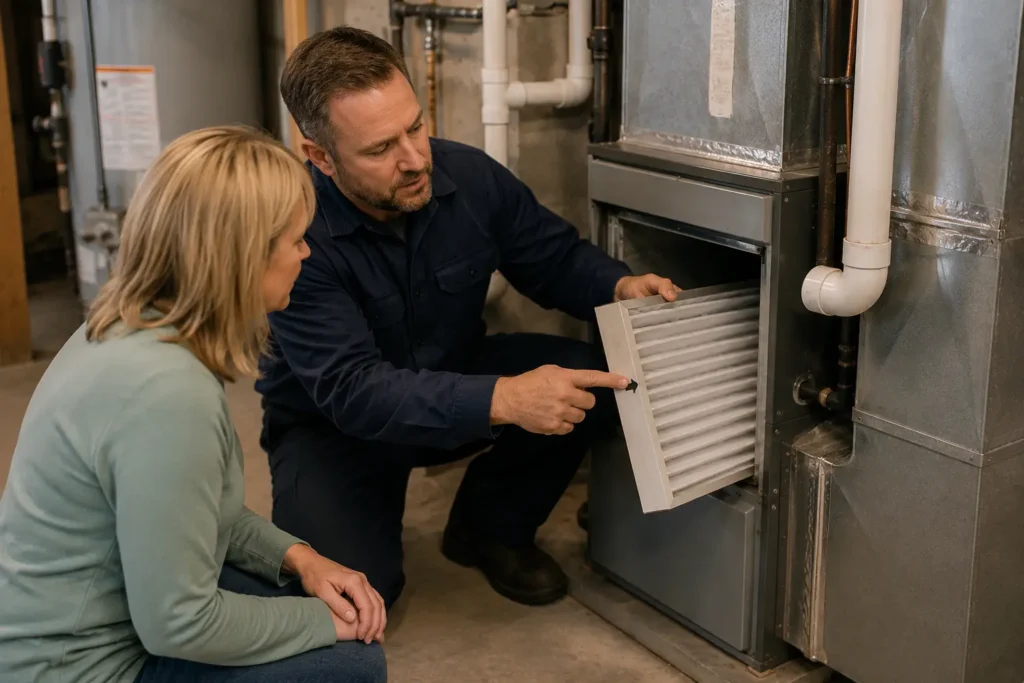
Most furnaces keep the filter in a slot near the return air duct or inside the blower compartment, usually behind a small panel that opens without tools. Pull the old filter out and the size is printed right on the cardboard frame, the same three numbers needed to buy a replacement. Look for a small arrow printed on that frame too. It needs to point toward the furnace, in the direction air actually flows through the system, and installing it backward is one of the most common mistakes homeowners make.
Frequently asked questions
How do I know what size filter my furnace needs?
The size is printed directly on the cardboard frame of the current filter, usually three numbers like 16x25x1. If the old filter isn’t handy, the furnace’s owner’s manual lists the correct size, or a technician can measure the slot during a service visit.
Is it bad to change a furnace filter too often?
Not really. Changing a filter before it’s dirty wastes a few dollars but causes no harm to the system. The only real downside is cost, and even that’s minor since basic filters typically run anywhere from a few dollars to around thirty dollars depending on type.
Do the furnace and air conditioner use the same filter?
In most homes, yes. A standard forced-air system uses one filter for both heating and cooling, since the same blower and ductwork handle both. That’s part of why filter checks matter year-round, not just in winter.
Do washable filters need to be replaced eventually?
Washable filters get cleaned rather than replaced on the usual schedule, typically rinsed and dried once a month. But the material wears down over years of use, and most manufacturers still recommend full replacement every few years even for washable models.
A furnace filter is one of the cheapest parts of the whole system and one of the easiest to forget. Check it monthly, replace it somewhere inside the range for its type, and pay more attention to what it actually looks like than to what the calendar says. That habit alone prevents a surprising number of avoidable furnace problems every winter.