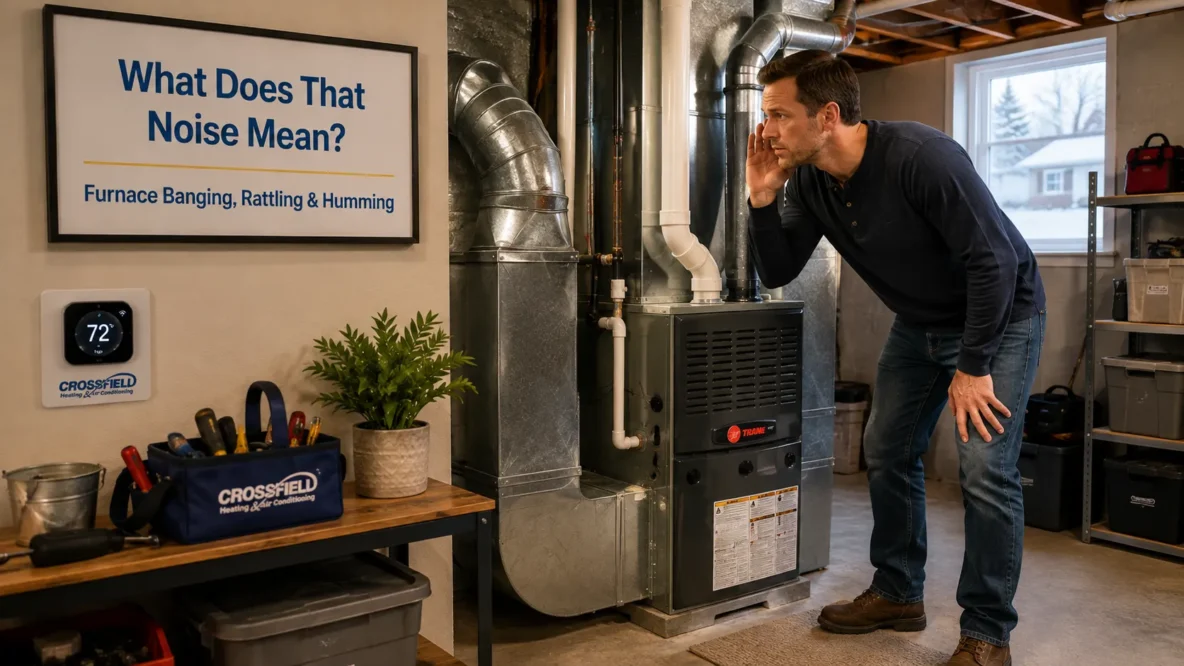
You’re sitting in the living room and the furnace kicks on like it does a hundred times a winter. Except this time it doesn’t sound right. Maybe it’s a bang. Maybe it’s a rattle that wasn’t there last month. Maybe it’s just louder than usual. Whatever it is, you notice it, and now you can’t stop noticing it.
Some furnace noise is completely normal. A gentle hum while it runs, a soft click when it starts, a little tick from the ductwork as it warms up and none of that means anything’s wrong. But there’s a difference between the sounds your furnace always makes and a new sound it just started making. That second kind is worth paying attention to because furnaces don’t usually go from fine to broken overnight. They tell you first.
Below is a rundown of the most common noises we hear about from homeowners in the Rochester area, what’s usually behind each one.
Furnace making a banging noise
This is the one that gets people out of their chair. A loud bang, sometimes right when the furnace starts up, can mean a couple of different things.
The most common cause is delayed ignition. Gas is supposed to light the moment it reaches the burners. If the burners are dirty or the gas pressure is off that gas can build up for a second or two before it finally ignites and when it does, it goes with a small bang instead of a smooth light-up. It sounds scarier than a lot of furnace problems because it genuinely is one of the more serious ones. Repeated delayed ignition puts stress on your heat exchanger, and that’s not a part you want to gamble on.
Banging can also come from your ductwork. Metal ducts expand as warm air moves through them and contract as they cool and depending on how your system was installed that movement can produce a real thump. This kind is usually harmless, but it’s not something you should assume without having it checked, especially the first time you hear it.
Furnace making a rattling noise
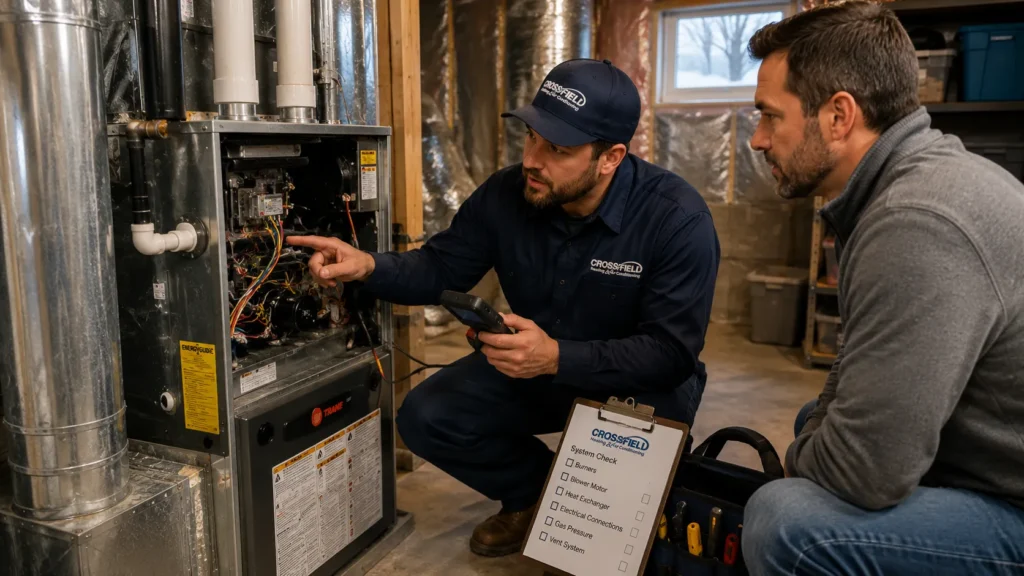
Rattling is often the least serious noise on this list and occasionally the most serious. The difference matters, so let’s separate them.
Most of the time, rattling means something is loose. A service panel that wasn’t seated back on tight, a screw that’s worked itself free or a mounting bracket that’s vibrated loose over a few years of running. These are simple fixes.
The one we don’t want you to ignore is a rattle that shows up along with other symptoms, a burning smell, soot near the furnace or a sense that something changed after the unit overheated. That combination can point to a cracked heat exchanger which is the part responsible for keeping the combustion gases separate from the air blowing into your home. A crack there can let carbon monoxide into your living space and CO doesn’t have a smell or color to warn you.
Furnace humming or buzzing
A quiet hum while your furnace runs is just the sound of the blower and other motors doing their job and that’s normal and you shouldn’t expect silence. What’s worth flagging is a hum that’s louder than it used to be or a buzz that wasn’t there before.
Buzzing is usually electrical. It can be a loose wire vibrating against the cabinet, a failing capacitor or a transformer that’s starting to go. None of these are something to poke at yourself; furnaces run on a mix of household voltage and low-voltage controls and the two don’t mix well with guesswork. If the buzzing is new and it’s getting louder over a few days that’s your sign to call before it turns into a bigger repair.
Furnace squealing or screeching
If it sounds like a small animal is unhappy inside your furnace, you’re almost certainly hearing the blower motor. Squealing and screeching usually trace back to worn bearings or on older belt-driven furnaces, a belt that’s slipping or cracked. Bearings need lubrication to spin quietly, and once they dry out, that’s the sound you get.
This one tends to get worse, not better and it can end with the motor seizing up completely if it’s left alone too long. Blower motors aren’t cheap to replace, so a squeal you catch early is usually a much smaller repair than the same squeal three months later.
Furnace making a clicking noise
A single click when your furnace starts and another when it shuts off is completely normal, that’s just the igniter doing its job. Repeated, rapid clicking, though, especially if the furnace tries to start and doesn’t quite catch, usually means the igniter or flame sensor is struggling. Sometimes it’s as simple as a flame sensor that’s coated in a thin layer of residue and can’t sense the flame properly anymore. It sounds minor but a furnace that can’t confirm it’s lit will shut itself down as a safety measure.
Furnace whistling or hissing
Whistling almost always comes down to airflow. Air is being forced through a space that’s too small for it, a clogged filter, a closed vent or ductwork that’s leaking somewhere along the line. It’s rarely dangerous, but it does mean your system is working harder than it needs to which shows up on your energy bill eventually.
A hiss is different from a whistle, and it’s worth knowing the difference. If you hear a steady hiss near the furnace itself, especially with any hint of a rotten egg smell, that’s a possible gas leak. Leave the house, don’t touch anything electrical on the way out and call your gas utility or 911 before you call an HVAC company.
What you can check yourself?
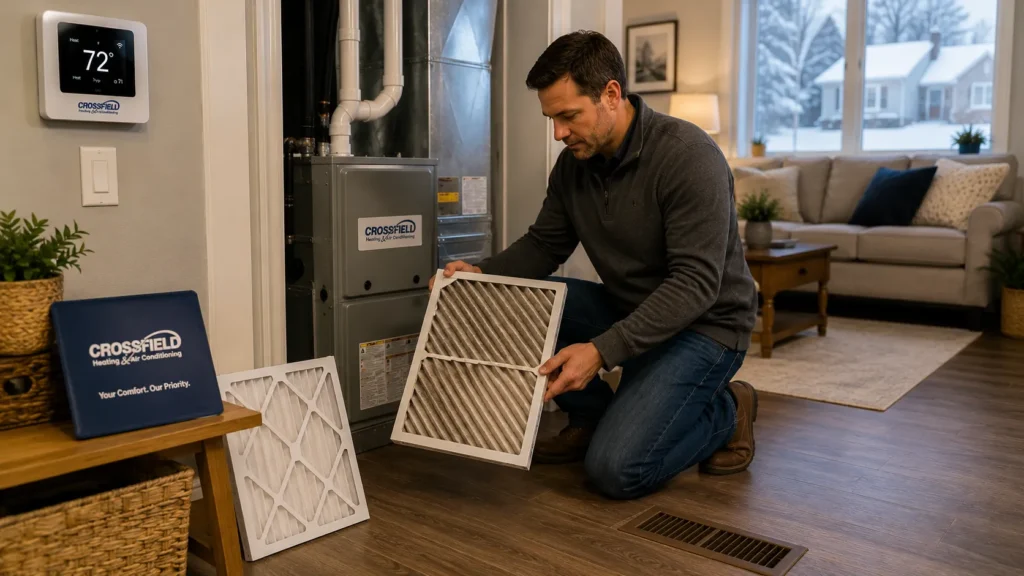
Before assuming the worst, there are a few easy things worth checking:
- Air filter – A dirty filter restricts airflow and can cause whistling and it forces the whole system to strain. Check it monthly during the heating season and swap it when it looks gray or clogged.
- Vents and registers – Make sure furniture, rugs or curtains aren’t blocking them. Closed vents create pressure the system wasn’t designed for.
- Access panels – If you hear rattling, a quick visual check (with the furnace off) for a loose panel can save you a service call.
- Breaker and thermostat – Obvious but worth ruling out before anything else.
If you’ve checked all of that and the noise is still there, it’s time to call rather than keep listening to it.
When should you take instant repair?
A few situations deserve a same-day call, there’s no time to wait.
- A burning or hot electrical smell along with the noise
- Any hint of a gas smell
- A noise that’s clearly getting worse day to day
- The furnace shutting itself off repeatedly
None of these are things a Rochester winter gives you time to sit on.
How does the furnace usually warn you?
Almost every furnace noise on this list starts small. A slightly loose panel becomes a loose panel plus a stressed bracket. A dry bearing becomes a seized motor. A little delayed ignition becomes a cracked heat exchanger. The furnace almost always gives you a heads-up before something fails completely and the trick is not talking yourself out of what you’re hearing.
Crossfield Heating & Cooling has been diagnosing furnace noises across Monroe, Wayne and Ontario counties for over 30 years. If your furnace has picked up a new noise, give us a call at 585-872-4420 or request service online and we’ll figure out what it’s trying to tell you before it turns into a no-heat call.
Frequently asked questions
Is it normal for a furnace to make any noise at all?
Yes. A soft hum while running, a click at startup and shutdown and occasional pops from the ductwork as it heats up are all normal. What matters is whether the sound is new, getting louder, or paired with another symptom like a smell.
Can a noisy furnace be dangerous?
Some noises are just annoying, others point to something serious, like delayed ignition or a cracked heat exchanger. Since it’s hard to tell the difference without opening the unit, it’s safer to have a technician check anything that sounds new or unusual rather than guess.
How much does it cost to fix a noisy furnace?
It depends entirely on the cause. Tightening a panel costs nothing but a visit. A blower motor replacement is a bigger investment. Most technicians, including our team, will diagnose the noise first and give you a clear price before doing any repair.
Should I turn my furnace off if it’s making a loud noise?
If you smell gas or something burning, yes. Turn it off and call right away. For noises like rattling or squealing without any smell, it’s usually fine to leave it running until a technician can take a look, though it’s still worth calling soon rather than waiting out the season.